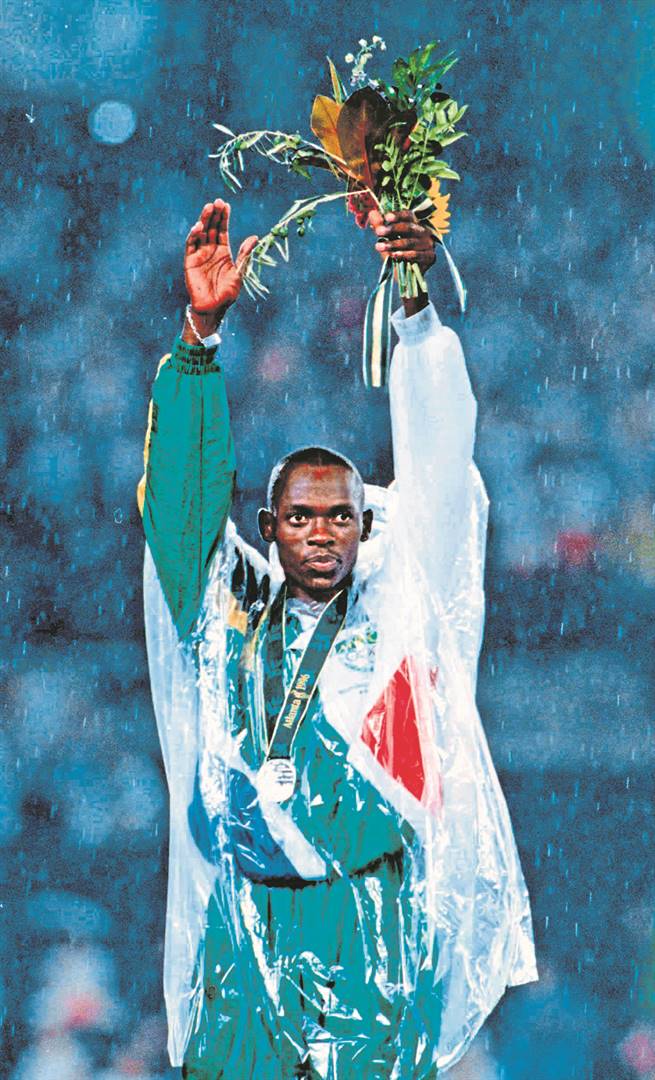
More Than an Olympic Medal
In the years following the end of apartheid, South Africa was searching for heroes who could unite a nation still healing from decades of division. The country had achieved political freedom in 1994, but the journey toward equality and national pride had only just begun. Amid this period of transformation emerged a quiet, determined runner from Potchefstroom whose greatest victory was measured by far more than the stopwatch.
I still vividly remember the euphoria that swept through our home as Sepeng crossed the finish line. My family erupted with pride, and it felt as though the entire nation was celebrating alongside us. In that unforgettable moment, South Africans from every walk of life shared in the joy of witnessing one of our own stand on the Olympic podium. His silver medal wasn’t just a personal triumph; it was a victory for a young democracy eager to prove itself to the world and a reminder that our country’s greatest strength lay in the talent and determination of its people.
From Township Roads to the Olympic Stage
Born on 30 June 1974 in Potchefstroom during the apartheid era, Sepeng grew up in a country where opportunities for Black athletes were severely limited. Despite his natural talent, the barriers created by racial segregation made it incredibly difficult to pursue elite sport.
His potential was recognised by coach J.P. van der Merwe, who fought to secure Sepeng a place at Potchefstroom Boys High School, an Afrikaans school that rarely admitted Black students at the time. The move proved life-changing, giving Sepeng access to better coaching and facilities that allowed his extraordinary talent to flourish.
As South Africa returned to international sport after years of isolation, Sepeng quickly established himself among the world’s finest middle-distance runners. He represented a generation of athletes eager to prove that South Africa belonged once again on the global sporting stage.
Atlanta 1996: A Race That Changed History
Nothing prepared the nation for what unfolded on 31 July 1996.
Lining up against some of the fastest 800-metre runners in the world, Sepeng ran the race of his life. Chasing Norway’s Vebjørn Rodal down the final straight, he crossed the finish line in a South African record time of 1:42.58, earning the country’s only silver medal of the Atlanta Olympics.
More importantly, he became the first Black South African to win an Olympic medal after apartheid and the first Black South African to win an Olympic athletics medal, marking a watershed moment in the nation’s sporting history.
For many South Africans, the medal represented something far greater than second place. It demonstrated that talent, when finally given opportunity, could compete with the very best in the world.
An Inspiration Beyond Sport
Sepeng’s success resonated in communities that had long been excluded from elite athletics. Young runners from townships and rural areas suddenly had someone who looked like them standing proudly on an Olympic podium.
His achievement inspired countless future stars, including world champion Mbulaeni Mulaudzi, who openly admired Sepeng as his sporting hero.
Reflecting on Mulaudzi’s rise years later, Sepeng recalled:
“He told me when he was a student he wanted to be like me. He never thought he was gonna beat me.”
His influence extended well beyond medals, helping shape a new generation of South African middle-distance runners.
Respect Earned Around the World
Although Sepeng never captured Olympic gold, he established himself as one of the world’s premier 800-metre athletes throughout the 1990s and early 2000s.
His achievements included:
- Olympic silver medal (Atlanta 1996)
- World Championships silver medal (Seville 1999)
- Two Commonwealth Games silver medals
- Multiple international victories on the IAAF circuit
- South African 800m record holder for many years
British Olympic legend Kelly Holmes, herself a double Olympic champion, admired Sepeng so greatly that she encouraged him to continue competing after the Athens Olympics.
His coach Jean Verster revealed:
“She was so convincing that he could hardly ignore the advice.”
Such respect from fellow champions reflected the standing Sepeng enjoyed within international athletics.
A Symbol of the Rainbow Nation
Nelson Mandela often spoke about sport’s ability to unite people across racial and cultural divides.
Mandela famously said:
“Sport has the power to change the world. It has the power to inspire. It has the power to unite people in a way that little else does.”
Few athletes embodied those words more completely than Hezekiel Sepeng.
In the fragile years following apartheid, every international success carried enormous emotional significance. Sepeng’s silver medal reminded South Africans that excellence belonged to everyone, regardless of race or background.
His achievement became part of a broader national story alongside the 1995 Rugby World Cup victory and Josia Thugwane’s Olympic marathon gold later that same year, helping redefine what was possible for a democratic South Africa.
A Legacy That Lives On
Like many athletes, Sepeng’s career was not without setbacks, including later controversies that affected the final chapters of his competitive life. Yet those challenges cannot erase the impact of what he accomplished during South Africa’s most important period of transition.
Today, Hezekiel Sepeng remains one of the pioneers of modern South African athletics. His journey from a young boy growing up under apartheid to an Olympic medallist inspired a nation finding its feet in freedom.
His silver medal represented something priceless: belief.
For thousands of aspiring athletes, it proved that dreams once considered impossible could become reality.
More than a runner, Hezekiel Sepeng became a beacon of hope, perseverance and national pride. His story reminds us that sometimes the greatest victories are not measured in gold medals, but in the lives inspired and the barriers broken.